When my wife and I were still Protestant, but attracted to Catholicism, one of my issues was the Catholic practice of invoking the saints during prayer. In my boyhood I had been taught that this was little short of necromancy. However, I was just beginning to understand that Catholics don’t pray to the saints instead of praying to God, but in addition to doing so. For Catholics, this is an extension of the practice of all Christians to bear one another’s burdens and pray for each other. As we read in the Epistle of James, “The prayer of a righteous man has great power in its effects.” If I might ask a good and holy friend to pray for me, why not ask the mother of my Lord, who is even holier?
Still, the practice was troubling, because, after all, couldn’t it happen that asking for the intercession of the saints might displace petitioning God Himself? In fact, I knew that it could happen. An Episcopalian lady I knew, herself a fallen-away Catholic, told me that she “felt closer” to Mary than to Jesus. This appalled me.
As I came to learn, it also appalls the Catholic Church. Time and again, the Church emphasizes that wholesome Marian prayer is centered not on the Virgin herself, but on Christ. At the wedding feast in Cana, where we know Mary to have interceded with her son on behalf of friends who had asked for her help because no more wine was left, she didn’t say to the servants “Do whatever I tell you,” but “Do whatever He tells you.” When I learned to pray the Rosary, I found it helpful to think of Mary alongside me, helping me speak to her Son, speaking to Him along with me.
A Catholic friend of mine helped me put this in perspective. “We want all the good stuff,” he said cheekily. Almost all the good stuff in the spiritual life is risky, but although the Church knows this, she views the risk differently that Protestants do. Traditional forms of Protestantism are risk-averse; their tendency is to view all spiritual risk as impermissible. But the Catholic view is that we should embrace all the good stuff while rejecting all the distortions. Don’t let the harmful things frighten you from enjoying the beneficial ones. Don’t let the false doctrines frighten you from embracing the true. From a Catholic point of view, that would be like cutting off one’s nose to spite one’s face.
For example, to avoid unhealthy attitudes toward the dead, an Evangelical will decline to invoke the intercession of the saints at all. To avoid the temptation of drunkenness, a Baptist will use grape juice, not wine, to commemorate the sacrifice of Christ. To avoid the danger of polytheism, an old-fashioned Unitarian will reject the doctrine of the Trinity (though, curiously, modern Unitarians embrace every novel doctrine except the Trinity). Matters have gone so far that to avoid self-righteousness, some liberal Protestants decline to believe in God at all.
By contrast, a Catholic asks the saints to pray for him, but in the same spirit in which he would ask his dearest and holiest friends to pray for him. He celebrates the conversion of the Eucharistic bread and wine into the Body and Blood of Christ, but he doesn’t believe in using wine to get drunk. He affirms the Three Persons because they really are Three Persons, but insists that they are only One Substance. And he earnestly believes in God, but instead of taking credit for his belief, he regards it as God’s gift.
The temperamental difference between the two attitudes toward risk cuts deep in theology, and may be one of the reasons why putting an end to the schism with Protestantism is so difficult – it was certainly one of mine. But I think the difference runs through other aspects of life too.
Consider the reluctance of most modern philosophers to think big. Instead they debate one tiny question at a time, but at interminable length. Granted, a person who thinks big may make big errors. But often even the tiny questions can’t be seen clearly, except in the light of a larger framework of thought. Their answers don’t make sense, apart from a background of answers to a host of other questions.
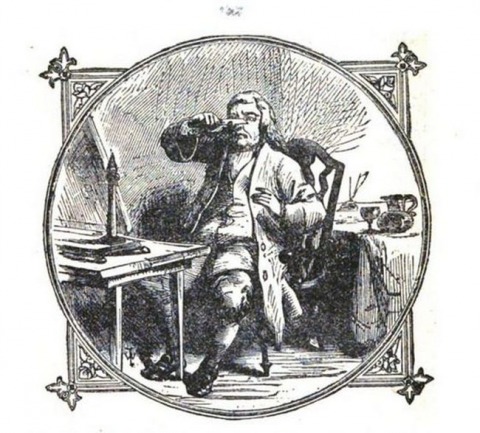
Note: The illustration to this post, “Don’t Cut Off Your Nose to Spite Your Face,” is from a book by the nineteenth-century Baptist preacher Charles H. Spurgeon. Never let it be said that I don’t acknowledge my debt to the Protestantism of my boyhood!