


How much difference do you think it makes whether the president is a good man or a bad one? I think it makes rather a lot. But consider carefully before you answer.

Question:
I have begun reading Of the Laws of Ecclesiastical Polity by the Anglican divine Richard Hooker. Following a discourse on the different kinds of Law instituted by God (eternal law, divine law, natural law, and so forth), Hooker writes,

The vice of pride lies not so much in being sure we are right, but being sure we are good. We seem to get this backwards. It is an insidious mistake.
Some of us even take pride in moral skepticism, thinking it a proof of our virtue.
Others take pride in not being such fools as to think such a thing.

Ancient books about politics spent as much time talking about friendship as about justice. Books written for the training of young rulers, called “mirrors for princes,” used to warn that tyrants have no friends, only sycophants.
I think many of my students consider such warnings odd. What are they doing there?
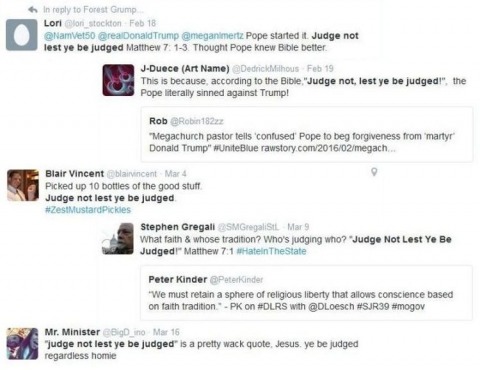
In the first century, who would have foreseen that two thousand years later Christ would be painted as a moral relativist by yanking his warning against hypocrisy, “Judge not, lest you be judged,” out of context?
This might be called called Twitter exegesis: Read no more than 140 characters of the Gospel at a time.


One might suppose that people live badly only because their thoughts are disordered. Just fix their thinking and they’ll be all right.

The distinction between humans and other creatures is under assault, and I have the greatest trouble suggesting to my students that we are rational beings and beasts are not.