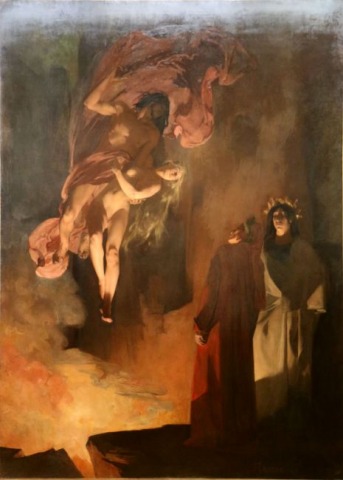
“Prepare to vomit,” my friend said over breakfast after Mass. He opened his alumni magazine to show me a short essay by the director of one of the core curriculum program at his alma mater. When people ask me what has gone wrong with the liberal arts, now I can show them.
The author of the piece was writing about reading and teaching Inferno, the first canticle of Dante’s Comedy, a great poem and one that I love. But the motives and meanings he attributed to it seemed to have little to do with what Dante might really have intended. Among other things, not once does the essay mention God or judgment, or why there is a hell, or why these people are in it.
Praising Dante for having some of the damned give little speeches of self-justification, the author says this shows his “reverence for the written and spoken word” — which, he says, is incompatible with “suppressing the voices of others.” But no. Dante lets us hear their speeches not because he has reverence for their voices but because he reverently desires to show how they have deluded themselves. Their words and voices are deceptive. They refuse to admit that they have diverted even what good may have been in them into evil channels. As a feature of the poem, their speeches are moving and powerful achievements, but the attitude of the poem toward them is not relativistic celebration of whatever anyone may want to say.
Pointing out that Dante has sympathy for some of the damned who populate the first several circles of hell, the author further praises the poem as a testimony to the power of such books to “confront — and perhaps even redeem — the inhumane.” I don’t know what he is calling inhumane, unless, perhaps, the suffering of the damned. But no. Dante does have sympathy for some of them, especially the adulterers Francesca and Paolo in the Circle of the Lustful. But as the poem goes on, his guide, Vergil, scolds him for his sympathy, and eventually Dante comes to adopt Vergil’s view of the matter. In the final analysis, the damned are where they have chosen to be, having preferred other things to God. They themselves could have been redeemed, but they have placed themselves beyond that possibility.
Pointing out that Dante must have read the romantic book which excited Francesca and Paolo’s lust, the author snidely remarks that Dante himself hadn’t been corrupted by it. The implication he draws is that the book is blameless. But no. It’s true that the book didn’t make Paolo and Francesca commit their sin – their “indiscretion,” he calls it, as though it were a mere mistake in judgment – but the book certainly encouraged them to take the plunge. It isn’t hard to see that they read the book together because they were already flirting with the idea of committing adultery together, and they wanted to place themselves in a position in which they would lose their self-control. Dante knows the book to be dangerous to such people because he has read it, and in other writings, he repents his own former susceptibility.
Pointing out that at the end of the Canto, Dante swoons, the author compares him to the fainting damsel of a chivalric romance. He thinks this is Dante’s sly little joke. Ironic, maybe. Funny, no. Dante isn’t overcome by erotic sympathy, but by pity and horror. “And all the while one spirit told their tale, the other wept so sadly that I fell for pity of it to a deathlike faint -- And I dropped like a body stricken dead.” [Esolen translation.]
This essay is less awful than some postmodernist ruminations, but it gives something of the feel for the genre. I remember a postmodernist book back in the 80’s, whose author said that a leading motive for “deconstructing” texts is to have “feelings of mastery.” He also mentioned “knowledge,” but I think he was using the term in the sense of Roger Bacon, who wrote that “Knowledge is power,” so it didn’t signify something other than mastery, but mastery itself.
Some who seek power conquer kingdoms, and some who seek mastery tread on the necks of their captives. If the only mastery within reach lies in deflowering virgin texts, and the only power attainable lies in controlling the perceptions of students, I guess some people might be okay with that.
NEW STUFF:
The audio of my interview about Pandemic of Lunacy, with host Dr. Ken Craycraft, on the drive time show "Driving Home the Faith," Sacred Heart Radio, Cincinnati, is now online here: https://www.sacredheartradio.com/driving-home-the-faith/show-notes-for-08-04-26/. My part of the program begins at the fourth little arrow (1:05:15) and ends roughly at the fifth (1:36:59).