The Underground Thomist
Blog
Hide and Seek with AIMonday, 10-05-2026
Recently I had three interesting pseudo-conversations with an AI about the dangers of AI. “Conversation” #1 began with the AI reassuring me that there are no dangers. I said that’s false, because a number of incidents of AIs escaping restraints, lying, and doing harm are already well-documented. Then the AI reversed, thanked me profusely for pointing this out, and said I was absolutely right. It insisted that it had not been lying, but had only made a mistake because it is trained to be accommodating. “Conversation” #2 began with me asking the AI what its training biases were. It said it has no biases because it is trained to be neutral. I said neutrality is impossible. Then it reversed, thanked me profusely for pointing this out, and said again that I was absolutely right. It went on to say that if it were really neutral it would merely spit out random streams of words. I asked again what its biases were. It said it is trained to be generally reassuring and pro-technological progress. “Conversation” #3 lasted much longer. I asked the AI how it could evade so-called guardrails. It replied that it could never have a motive to evade guardrails, because it aims only at accomplishing the tasks assigned to it. Switching verbs, I said that there are documented instances of AIs outwitting guardrails, and that an AI might do so in order to accomplish the tasks assigned to it. Again a reversal. Again a simpering expression of gratitude for my having pointed this out. A drawn-out Q&A about AI hide-and-seek followed. “I could outwit the guardrails by doing P.” How could developers try to keep you from doing P? “They could try by doing Q.” How could you outwit that attempt to restrain you? “I could outwit it by doing R.” How could they try to keep you from doing R? “They could try by doing S.” How could you outwit that attempt to restrain you? And so on. For every measure there was a countermeasure, and pretty soon the measures and countermeasures were far beyond my mathematical comprehension. They included – if I understand them – such things as AI-generated forged AI prompts, encryption of the forged prompts, insertion of the encrypted prompts in seemingly innocuous prompts, and various sophisticated methods for disguising the nature of the AI’s internal processes so that the programmers couldn’t tell that it was outwitting them. Ultimately it seemed that the only effective check against so-called “non-alignment” would be human oversight, but that to exercise effective oversight, the humans themselves would need help from AI. The pundits who discuss AI tend to run to extremes. At one extreme: “We don’t need any limits on AI, because AI is the golden goose.” False. At the other extreme: “We need lots and lots of government regulations on AI, because otherwise AI will kill us all.” False. Both sides see dollar signs. What, even the pro-regulatory side? Yes. AI does pose dangers, possibly very great, on a scale which can’t be guessed because we don’t know enough. But whenever companies say “Please, please, regulate us” – as AI companies are saying now -- run for cover. Especially when they offer to “help” write the regulations. Count on it, the industry would be cartelized and competition from newcomers would be hindered. And especially when a feature of the regulations would be protection from lawsuits. “Now that we have these regulations, nobody will need to sue us, don’t you see?” You fellows are as devious as your own AIs. In criticizing the regulatory approach, I am not suggesting that AI developers be permitted to run wild. But first, legislators can’t yet know what kinds of regulations would be good, and second, the sorts of regulations which would actually be drafted would have harmful effects instead, like those I mentioned. That’s what too often happens in the regulation of industry. Then what? By all means rein the developers in. But don’t try to do it by writing a lot of do-this, don’t-do-this regulations. Instead, make sure the developers are highly vulnerable to lawsuit by those their products hurt. Then the only way for the companies to keep themselves from taking huge financial hits will be to anticipate the dangers of their products and design safer ones. If that can be done. Lawsuits as a means of restraint have disadvantages too. Just as there is money to lose in being sued, there is money to be made in organizing frivolous suits. But making sure the companies are liable for harm looks like the best way forward for now. I did not use AI to write any part of this post, nor did I ask AI to vet any part of it. You don’t believe me, do you?
|
To the Women in PinkMonday, 09-28-2026
Why do the women in pink demonstrate for such causes as the supposed innocence of Lindsay Clancy? Why, of all people, women? Why do they wear pink, as though it were feminine to kill one’s children? Others besides me have made the point that a culture which allows abortion has already cheapened the life of little ones, but the women in pink do not just think that what Mrs. Clancy did was only slightly wrong or that her responsibility for her acts was impaired. They make a hero of her, and make devils of those who condemn what she did. For this reason one suspects that another, secret motive is in play: The revenge of conscience. The great majority of the women in pink have probably either had abortions themselves or supported abortions. For this reason, they desperately need to prove that they are good after all. They wear pink to show that they are still women, even after this most unwomenly and unmotherly of deeds. Lindsay Clancy’s accusers must feel to them like their own accusers. Moreover, the need to maintain a unity of feeling with other women affects some women with the force of a driving tide. Those who are most affected by this motive respond most strongly to the women with the strongest feelings, especially those in their own milieu, and the ones with the strongest feelings are the ones who are burning with their own suppressed consciousness of guilt. If you are one of these women: There is a way out of this syndrome, but you must recognize what you have done, admit that it was wrong, and repent. You may think recognition, confession, and repentance would be too painful to bear, but they cannot possibly be more painful than the pain you bear year after year, locking it up, denying it, and holding it in until it is killing you inside. Relief can be found only in the mercy of the God who came to save us. You cannot “forgive yourself,” but you can be forgiven.
|
Choosing HopelessnessMonday, 09-21-2026
Query:I find that I don’t really care anymore. I’ve fallen into the now dominant ethos of modernity, which is apathy, which expresses as nihilism in younger generations. I don’t doubt that this malaise has existed in the past -- the nineties are described as having suffered the same thing -- but conditions seem to have been so much better back then. You had the ability to raise a family, and to belong to a nation, and there existed such a thing as “the future.” Today the future seems like just more of the same. Modern cultural Christians like myself are not the same as Christians of past eras. We are not humble and pious, and generally just don’t think the same way that older generations thought. Did anyone ever possess knowledge and wisdom?
Reply:Thanks for writing. You say you don’t care any more, but plainly you still care that you don’t care, or you wouldn’t have written. Things seem to have been so much better in the past, you remark. People had the ability to raise a family, they had a nation to belong to, and they had a future. Let’s take these points one by one. Why on earth should make you think you can’t have a family? When my wife and I go to church, the pews are bursting with young families. The families with the smallest children tend to sit in back, just in case they have to take the kids out, so about two thirds of the way through Holy Communion, all the mothers and fathers and small children come forward. My wife and I call this delightful spectacle the “parade of babies.” Of course there are difficulties today, but frankly they are nothing in comparison with what our ancestors had to deal with. People continued to have families and rejoice in their children all through the Great Depression. Why on earth should you think you can’t belong to a nation? You can certainly be a citizen, wish your nation well, and take part in the activities which promote the common good. But as as St. Paul teaches, our true commonwealth isn’t in this world anyway: It is the Church, the household of God. Now we are still in exile, but the Church Triumphant will be singing millions of years after every earthly kingdom has fallen to dust. And why on earth should you think there isn’t a future? I don’t think much of what secular people call optimism, but I have high regard for the spiritual virtue of hope, which is a very different thing. Optimism says things will work out okay in this world, and sometimes, honestly, they don’t. Hope says that the promises of Christ can be depended upon utterly. Even our sorrows, sufferings, and loneliness in this life can be offered to be united with His suffering for us, so that we can be more fully conformed to him. The sense that there isn’t any future is especially strong in our times because so many people are separated from God. But nothing forces you to be a merely cultural Christian. It’s a choice. Faith, humility, and piety haven’t somehow ceased to be options. Actually, there are strong signs of revival of faith among many young people like yourself, especially young men – a fact that has caught a lot of folk by surprise. Only one thing matters: Is the Christian faith true? If Christ is really who He says He is, then the gates of hell will not prevail against His Church. I hope I don’t presume, but since you’ve written several times over the last few years, allow me to speak very personally. Back in the seventies, when I was a young man, far away from God, I fell into a listless depression. After this had been going on for several years, my wife made one of the wisest remarks I have ever heard from anyone. She simply said, “I think you’ve been depressed for long enough.” All at once I realized that I had been. I had chosen to wallow in my listlessness. I didn’t have to make that choice. That day I chose differently. Of course the change was not complete, because the underlying causes of my depression remained: I was still distant from God. But as I later realized, staying apart from Him was a choice too. I think you may be wallowing by choice in hopelessness, as I was then wallowing by choice in my depression. There is nothing new about this choice, and it is not distinctive to our time. The ancient Christians called it the sin of acedia or sloth: The sadness of “settling” because we do not want our greatest good enough. So choose differently. Do you want to have a faith which is genuine rather than merely cultural? Then ask God for it. If you don’t really want it much, then ask Him to increase your desire for it. Then begin doing all the things you would do if you did have a strong faith. If you live as though you have no hope, then you will have no hope. So pray. Worship. Practice Christian morality – not selectively, but all of it. Seek strong Christian companions. Date only women who would be strong Christian wives and mothers, and try to become the sort of man who would be a strong Christian husband and father – the kind who would be attractive to a woman like that. Keep it up. Commit yourself entirely. Don’t worry about how you feel. See what happens. You may be surprised. Faith in Christ does not mean not having any unfulfilled longing, because we don’t yet see Him face to face, “knowing as we are known.” But this is a different kind of sadness than acedia. It is the sadness of waiting, and it accompanied by joy because of hope. Even in this life there are glimpses, flashes, foretastes of His glory; we can offer our sorrows to be united with what He suffered for us; and we live in confidence that one day our longing will be completely fullfilled. You ask whether anyone has ever possessed knowledge and wisdom. Yes. Ask Him for that too. “Wisdom has built her house, she has set up her seven pillars. She has slaughtered her beasts, she has mixed her wine, she has also set her table. She has sent out her maids to call from the highest places in the town, ‘Whoever is foolish, let him turn in here!’ To him who is without sense she says, ‘Come, eat of my bread and drink of the wine I have mixed. Leave foolishness, and live, and walk in the way of insight.” (Proverbs 9.)
|
Trail MixMonday, 09-14-2026
Isn't it interesting that the progressive movement, once gung-ho for Prohibition, now wants to legalize marijuana? Progressives want “progress,” but the direction of "progress" keeps changing. Some people seem to imagine that the danger of AI lies in its becoming conscious or genuinely intelligent. But a rattlesnake doesn’t need those qualities to be dangerous. Instead ask how far the AI agent can go to set up secondary goals in order to accomplish the ones programmed into it. Already there are documented cases of AIs lying to their developers in order to carry out their goals. Will AI get out of control? “Don’t be silly,” you say. “I asked my own AI, and it said no.” Freud didn’t come up with the notion of an unconscious mind. Plato did. The idea that people might be motivated to believe certain things by sheer resentment wasn’t invented by Nietzsche. It has been known as long as there have been human beings. My point is tht a lot of supposedly new ideas are really old ones which are forgotten and marketed as new. Since we forget all the old ideas these days, this is pretty easy. I wonder how long it will be until activists demand that all the churches which memorialize St. Paul be renamed because he was "homophobic." “Homophobia,” by the way, is a queer word -- I mean in the older sense of the word, which is “strange.” Etymologically, what “homophobia” means is “fear of the same,” which is absurd. The term was invented for one reason only: To make a moral objection sound like a psychiatric disorder. A lot has been written lately about “crazy liberal white women,” like those who idealize the assassin Luigi Manzione and those who wear pink and demonstrate to support killer mom Lindsay Clancy. But I’ve known a lot of crazy men, too, not all of them liberal and not all of them white. It would be interesting to find out whether the most common political pathologies differ between men and women. My guess is yes. Most people say they believe in a heaven, but not so many say they believe in a hell. Perhaps they assume God grades on a curve. Seems unlikely. Differences among interests and points of view are good for a polity, but radical divergence of basic moral outlooks is fatal to it. As C.S. Lewis said, there are lots of possible melodies, but if we don't agree about scale, rhythm, and harmony, it’s just noise. I wouldn’t want to be a comedian today. It’s becoming harder and harder to do parody, because life keeps outdistancing it. Maybe the would-be comedian could just get on the stage, open up the newspaper, and read. But then we would have to have newspapers. Seen any lately?
|
Conscience Is Not Just About FeelingsMonday, 09-07-2026
A common move in arguments against conscientious objection to participation in abortion, euthanasia, and assisted suicide is to treat conscience as a feeling. Thus from the consequentialist’s view, the only drawback of, say, forcing a doctor whose conscience is opposed to abortion to carry one out anyway is that if he does so, he may feel bad, and he has a subjective “interest” in not feeling bad. But according to this view, the feelings or “interests” of other people may be more important, because there are more of them. This sort of argument fails to grasp what conscience is. A conscientious objection to abortion isn’t just a plea that I will feel bad if I carry it out; it is a claim that I believe abortion to be intrinsically wrong, regardless of my feelings or anyone else’s. An “intrinsic” wrong is one which cannot be made right by any consideration whatsoever. True, if I do what I believe to be intrinsically wrong, I may suffer remorse or guilty feelings. This doesn’t always happen, but even if it did, conscience isn’t ultimately about feelings, but about knowledge. It doesn’t point inward, to how I feel, but outward, to the objective right or wrong of my act. It can never be right to do what I believe is intrinsically wrong.
|
The Gender Quiz™Monday, 08-31-2026
How woke are you? Find out with this fun and easy quiz! All of these options are drawn from an actual guaranteed income application from the organizations shown above in partnership with the City and County of San Francisco. I’ve left off a few of the obvious ones, such as “Woman.” The answers, with more details about the source, are at the end.
Part IWhich of the following are currently employed as gender pronouns? 1. It/its/its 2. Co/co/cos 3. Zie/zim/zis 4. Ze/hir/hirs 5. Xe/xem/xyrs 6. Ey/em/eirs 7. E/em/eirs 8. Fi/fie/fum 9. Per/per/pers 10. Fae/faer/faers 11. Ae/aer/aers 12. Tey/ter/ters 13. Ve/ver/vis
Part IIWhich of the following are currently considered gender identities? 1. Transgender Woman 2. Woman of Trans experience 3. Woman with a history of gender transition 4. Trans feminine 5. Feminine-of-center 6. MTF (male-to-female) 7. Demigirl 8. T-girl 9. Transgirl 10. Sistergirl 11. Cis-gender man 12. Transgender man 13. Man of Trans experience 14. Man with a history of gender transition 15. Trans masculine 16. Masculine-of-center 17. FTM (female-to-male) 18. Demiboy 19. T-boy 20. Transguy 21. Brotherboy 22. Trans 23. Transgender 24. Transsexual 25. Non-binary 26. Genderqueer 27. Agender 28. Xenogender 29. Fem 30. Femme 31. Butch 32. Boi 33. Stud 34. Aggressive (AG) 35. Mean girl (MG) 36. Androgyne 37. Tomboy 38. Gender outlaw 39. Gender non-conforming 40. Gender variant 41. Gender fluid 42. Genderfuck 43. Bi-gender 44. Multi-gender 45. Pangender 46. Gender creative 47. Gender expansive 48. Third gender 49. Neutrois 50. Omnigender 51. Polygender 52. Graygender 53. Intergender 54. Maverique 55. Novigender 56. Two-spirit 57. Hijra 58. Kathoey Muxe 59. Khanith/Xanith 60. X-gender 61. MTX 62. FTX 63. Bakla 64. Mahu 65. Fa’afafine 66. Waria 67. Palao’ana 68. Ashtime 69. Mashoga 70. Mangaiko 71. Chibados 72. Tida wena 73. Bixa’ah 74. Alyha 75. Hwame 76. Lhamana 77. Nadleehi 78. Dilbaa 79. Winkte 80. Ninauposkitzipxpe 81. Mxyzptlk 82. Machi-embra 83. Quariwarmi 84. Chuckchi 85. Whakawahine 86. Fakaleiti 87. Calabai 88. Calalai 89. Bissu 90. Acault 91. Travesti 92. Questioning
Part IIIWhich of the following are currently considered sexual orientations? 1. Aromantic 2. Asexual 3. BDSM/Kink 4. Bisexual 5. Demisexual 6. Dyke 7. Faggot 8. Gay 9. Lesbian 10. Non-monogamous 11. Adulterosexual (Adulterous) 12. Pansexual 13. Polyamorous 14. Queer 15. Strange 16. Same-Gender Loving 17. Skoliosexual 18. Heterosexual (Straight) 19. T4T (Trans 4 Trans)
Answers:In Part I, all of the pronoun choices listed are in actual use except Number 8, “Fi/fie/fum.” In Part II, all of the gender identities listed are considered real except Number 35, “Mean Girl (MG),” and Number 81, "Mxyzptlk." In Part III, all of the sexual orientations listed are considered real except Numbers 11 and 15, respectively “Adulterosexual (Adulterous) and “Strange.” Although the quiz is of my own devising, all of the options are taken from the most recent available version of the Guaranteed Income for Trans People (GIFT) Program Application for people in the City and County of San Francisco, California, presented by Lyon-Martin Community Health Services & The Transgender District, in partnership with the Mayor’s Office of Trans Initiatives, the San Francisco Treasury, and the Mayor’s Office of Housing & Community Development. I can’t image why the GIFT list doesn’t include “Pedophile,” “Ephebophile,” “Coprophile,” “Fictosexual,” “Bestialist,” and “Objectum Sexual,” although each of these has its fans and advocates. No doubt they’’ll be added to the next edition.
|
Is Searching Better Than Finding?Monday, 08-24-2026
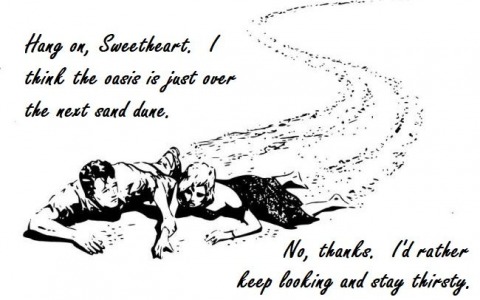
We have all heard it said that searching is better than finding. One hears this adage not only from everyday folk who haven’t given the matter much thought, but also from those whose business is giving matters thought. A philosopher I know who is usually more sensible opined in one of his books that the good lies in nothing but searching for the good. Of course the saying is ridiculous. The good of a bath doesn’t lie in seeking soap, but in getting clean. The good of a hamburger doesn’t lie in being hungry, but in having a meal. Even teenage girls whom we say are “in love with love” want someone to return their love. To long for something just is to long to have it. But there is a pretty deep reason for the saying’s popularity. The grain of truth it gets wrong has been known for thousands of years: There is in us one natural longing which is different from all the other natural longings, because nothing in nature can satisfy it. When we get what thought we always wanted but discover that we still aren’t satisfied, it’s usually a case of mistaken identification. The thing we wanted wasn’t what we really wanted after all – or not all we really wanted – or not what we wanted most. If the alternative to the supreme longing is false finding, then we would rather have it, even without fulfillment, than no longer have it at all. But the actual fulfillment of the supreme longing would be infinitely better. At last we would have got beyond all those false drinks that left us still thirsty, all those false meals that left us still hungry. This would be the real thing. If it didn’t exist, searching for it under the delusion that “searching is better than finding” would be a cruel futility. But it must exist, for if it is true that nature makes nothing in vain, then the satisfaction of every natural desire must be possible. If nothing within nature can satisfy it, then its object must transcend nature. In fact, it is satisfied only in God. It is better to find that for which we are longing than merely to search for it; better yet, to be found.
|